


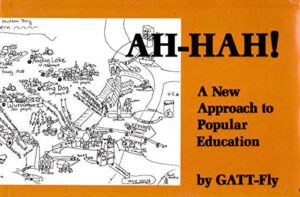
Ah-Hah!
This is one of our frequent go-to techniques for small and large group work. Created by the Canadian group, GATT-Fly, the Ah-hah! process is visual. It draws upon Latin American popular educators’ tools for doing structural analysis. Once a focus topic or issue is set by the group, the facilitator and group members begin asking questions about its current manifestation. The process begins with individuals making individual drawings on their own paper, and possibly sharing it in small groups before then contributing to creating one large group drawing. The process involves a series of steps to unpack underlying causes, power brokers, etc. it asks such questions as: “Who owns?”, “Who decides?”, “Who wins?”, “Who loses?” The final step is to use this visual map to identify key points where members of the group have leverage, where and what type(s) of intervention is possible to press for change, and priorities for action.
► FACILITATION TIPS:
- You do NOT have to have artistic talent for this to work!
- It can build group buy-in to judiciously invite the group to advise the illustrator/facilitator how to symbolize/depict certain people, an institution, a relationship. This enables greater cultural sensitivity and competency in the drawing.
- Excellent with youth and adults and in situations where people have different levels of knowledge and experience.
- Excellent in multilingual settings even with interpretation because it is easier for everyone to follow the conversation as it is depicted on paper, not just auditory learning.
- Excellent in working with people who are not literate since the map is totally or mostly symbolic/visual – little or no writing is involved.
- It literally can produce “Ah-Hahs!” when people make connections or see realities they had not previously known or understood. We personally can testify to this for workshops we’ve done in English, Spanish and Arabic.
- It underscores the point that visual learning tools can be more powerful than conversation only.
- Another beauty of this tool: the conversation can be had in several sessions over time, possibly coupled with some Participatory Action Research in between sessions to fill in missing information. The picture makes it easier to recap past discussions and add additional information and depth because of the visual record.