


TOOLS & TECHNIQUES
Ah-Hah!
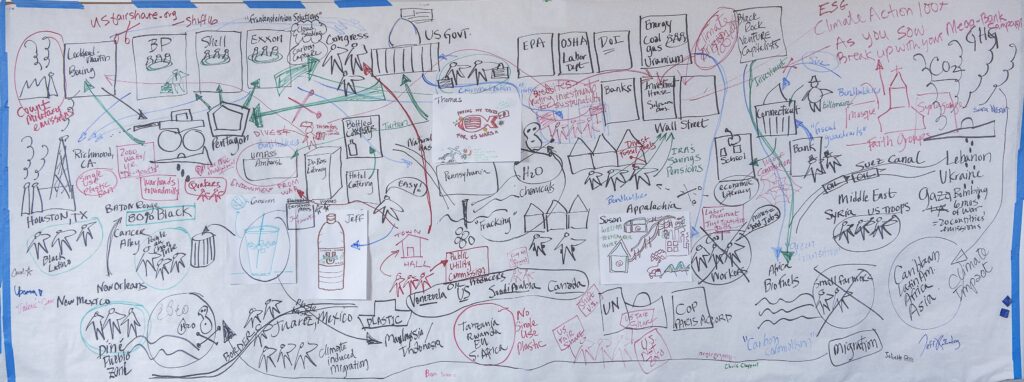
This is one of our frequent go-to techniques for small and large group work. Created by the Canadian group, GATT-Fly, the Ah-hah! process is visual. It draws upon Latin American popular educators’ tools for doing structural analysis. Once a focus topic or issue is set by the group, the facilitator and group members begin asking questions about its current manifestation. The process begins with individuals making individual drawings on their own paper, and possibly sharing it in small groups before then contributing to creating one large group drawing. The process involves a series of steps to unpack underlying causes, power brokers, etc. it asks such questions as: “Who owns?”, “Who decides?”, “Who wins?”, “Who loses?” The final step is to use this visual map to identify key points where members of the group have leverage, where and what type(s) of intervention is possible to press for change, and priorities for action.
► FACILITATION TIPS:
- You do NOT have to have artistic talent for this to work!
- It can build group buy-in to judiciously invite the group to advise the illustrator/facilitator how to symbolize/depict certain people, an institution, a relationship. This enables greater cultural sensitivity and competency in the drawing.
- Excellent with youth and adults and in situations where people have different levels of knowledge and experience.
- Excellent in multilingual settings even with interpretation because it is easier for everyone to follow the conversation as it is depicted on paper, not just auditory learning.
- Excellent in working with people who are not literate since the map is totally or mostly symbolic/visual – little or no writing is involved.
- It literally can produce “Ah-Hahs!” when people make connections or see realities they had not previously known or understood. We personally can testify to this for workshops we’ve done in English, Spanish and Arabic.
- It underscores the point that visual learning tools can be more powerful than conversation only.
- Another beauty of this tool: the conversation can be had in several sessions over time, possibly coupled with some Participatory Action Research in between sessions to fill in missing information. The picture makes it easier to recap past discussions and add additional information and depth because of the visual record.
Download a free copy of the “Ah-Hah!” manual here:
http://persuasionsanddesigns.com/index.php/resources)
Appreciative Inquiry
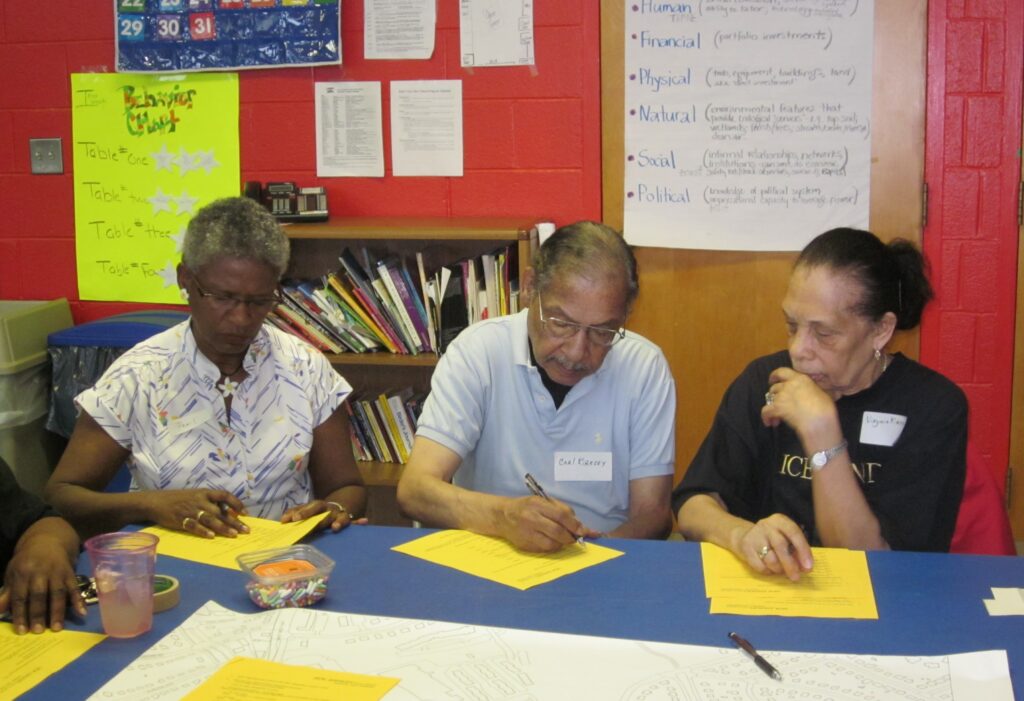
Much community organizing starts with identifying problems and goes from there in search of causes and strategies to address those causes. Appreciative inquiry inverts this and starts by inviting community members to identify what’s working, what they like – even love – about where they live, work, or go to school. (Whatever is the arena for action.) It then seeks to build upon those strengths, values, attractions, and resources to further enhance community/work/school life. This can be a powerful tool for generating ideas as well as a sense of ownership of the process, and strengthening a collective sense of agency.
► FACILITATION TIPS:
- This can work well with groups of children, teens, adults, and mixed-age groups.
- This can work well in multilingual and/or multi-cultural settings.
- Discussion questions can be answered by participants drawing pictures, using or enhancing geographic maps, making or responding to charrettes. (Charrettes are a process of collaborative design and/or planning – often using maps, 3-D blocks, etc. to help people talk about and visually show their ideas.) This can create more fun and more specific ideas and outcomes than what might be possible only through conversation.
- Unlike some other techniques this is more likely to build group energy than deplete it.
Check out these resources for more information:
A helpful academic analysis of Appreciative Inquiry from the Center for Appreciative Inquiry:
A psychologist explains how to apply Appreciative Inquiry:
For deeper background on the philosophy and technique – there is an Appreciative Inquiry Commons:
Ironically, the business world has fallen in love with Appreciative Inquiry. The self-declared global home for Appreciative Inquiry resources is Case Western Reserve University’s (CWRU) business school. Interestingly, they are combining it with the UN’s Social Development Goals in training a new generation of MBAs. (Appreciative Inquiry was developed at CWRU in the 1980s.)
For case studies, overview articles, how-to videos:
Coyuntural Analysis
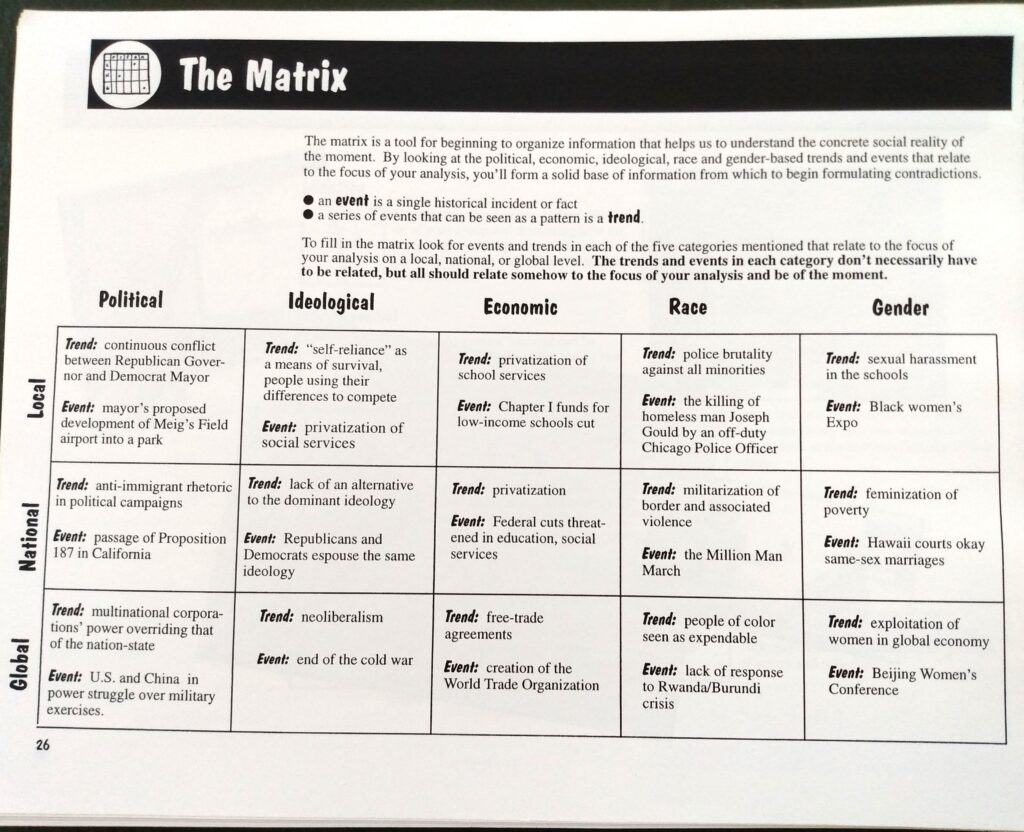
This is another one of our favorite processes developed by the skillful Chicago Office of the American Friends Service Committee, inspired by great popular education others have done in Central America and Canada.
“Coyuntura” is a Spanish word which means the intersection of various social forces and their effect upon a particular moment in history – generally, the present. It draws from the work of Antonio Gramsci. Conjunctural analysis captures a sense of movement; as differentiated from “structural analysis” which analyzes societal power structures and tends to be more static. The AFSC guide contains exercises and helpful coaching to go through identifying issues, conflicts and contractions, history, and visions for the future – ultimately identifying the principal contradiction in the moment, opportunities for change, and then deciding how to take action.
► FACILITATION TIP:
Mary Zerkel, author of Coyuntural Analysis, explains that one of the benefits of coyuntural analysis is that it more likely leads to action. “When we look at those aspects of our society that are seemingly static or structural (such as sexism or classism), we can become depressed or feel overwhelmed and unable to act. When we look at the conjunctural or the “moment,” we find temporary aspects of these structures that, because of their immediacy and their scaled-down nature, often lend themselves to short-term action.”
Gallery Walk
This simple technique can be used in different ways. It can be used to get people talking informally in one-on-ones and in small groups – explaining what they think, feel, and/or propose – and comparing notes. It tends to build energy and so is especially valuable to use during times of day when people’s attention and energy tends to slump – like after lunch or in the late afternoon. It is also a way to get a quick view of what has emerged from small groups rather than a lengthy report back session.
This can be step two in any kind of process where you have people making personal or small group lists, drawing pictures of their situation or an organizing strategy, etc. Once individuals or small groups have produced some sort of visual aid related to the discussion, they are invited to post that picture or list on the wall. Then, the facilitator offers instructions for how people will circulate to check out other’s ideas, discuss, etc. Circulation instructions depend on whether the visuals pertain to a small group or individual. If an individual, divide people up, and have multiple circulation rounds where some people do not circulate in each round.
► FACILITATION TIPS:
- Talking is optional for a Gallery Walk. If personal quiet reflection is desired, then the facilitator can invite individuals or small groups to post their newsprint sheets on the wall and then individuals move around the room(s) to study them at their own pace.
- If discussion is involved, in order for people to hear each other, it is necessary to encourage people to spread out their posted work. Depending on the number of people, unless a room is really large, it may mean asking some people to post on walls in a nearby hallway or adjoining room.
- Take note if anyone has particular sight or mobility needs. Presenters may need to adjust the height and locations of posters.
- This can also be done in a virtual workshop using Padlet. Groups can post outcomes on the digital board and the full group can quickly view them, rather than a lengthy report back session.
Download the full coyantura manual:
Games
Who doesn’t like to play games? This is a broad category of tools – from board games and puzzles, to role plays, to some parts of Popular Theater, to repurposing various children’s and adults’ toys and games. Games of various types can be used to teach economic, environmental, and social concepts and issues, build community, as well as generate positive energy and surprising insights. The sky and your creativity are the only limits.
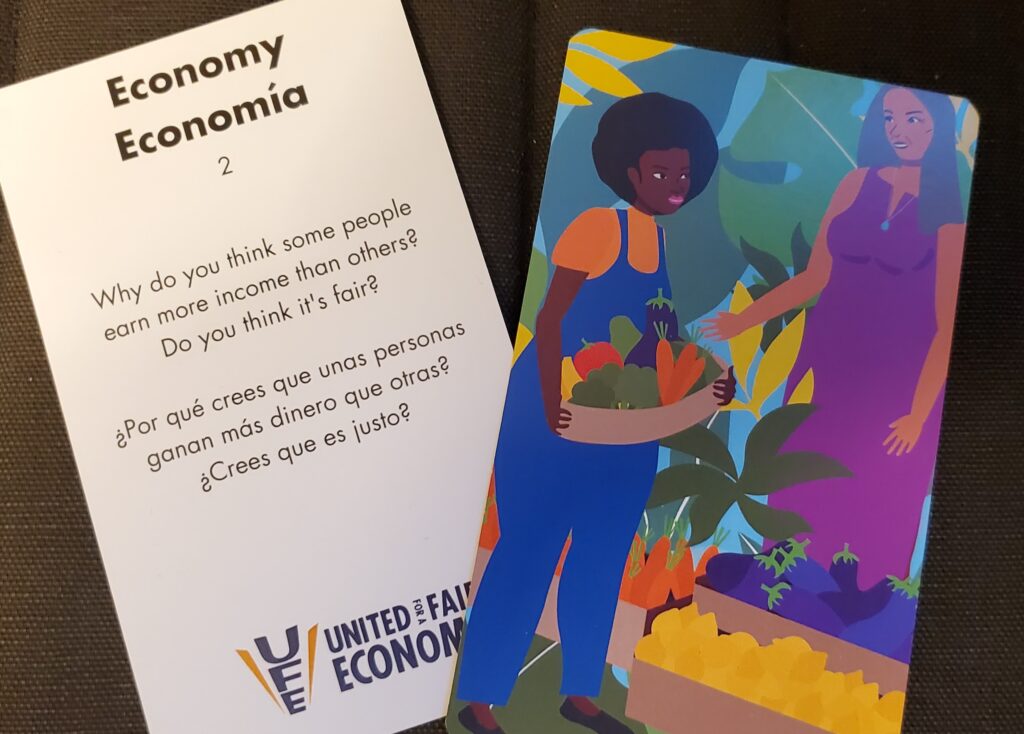
Here are two examples:
The Trade Game – Initially developed by the YMCA, this is an interactive role play where groups of people assume country identities and witness basic dynamics in global trade and finance as they try to build wealth in the face of deadlines and limited resources. Playing this is a great way to launch discussions about real-world economics, current trade rules and relationships – for teens and adults. Download instructions here.
The SAP Game — a combination of a board game and role play which looks at the cross currents of international debt and finance, the climate crisis, immigration/migration, gender, class and racial-ethnic oppression, and the role of the World Bank. An introduction to Neoliberalism rolled into a fun game. It can be played with up to about 40 people at a time. De-briefing can be focused in different directions, including the ramifications for the US or other wealthy nations, as well as nations on the borrower end of World Bank lending programs. Click here to contact Pamela Sparr for more information.
Living Sculptures/Live Illustrations
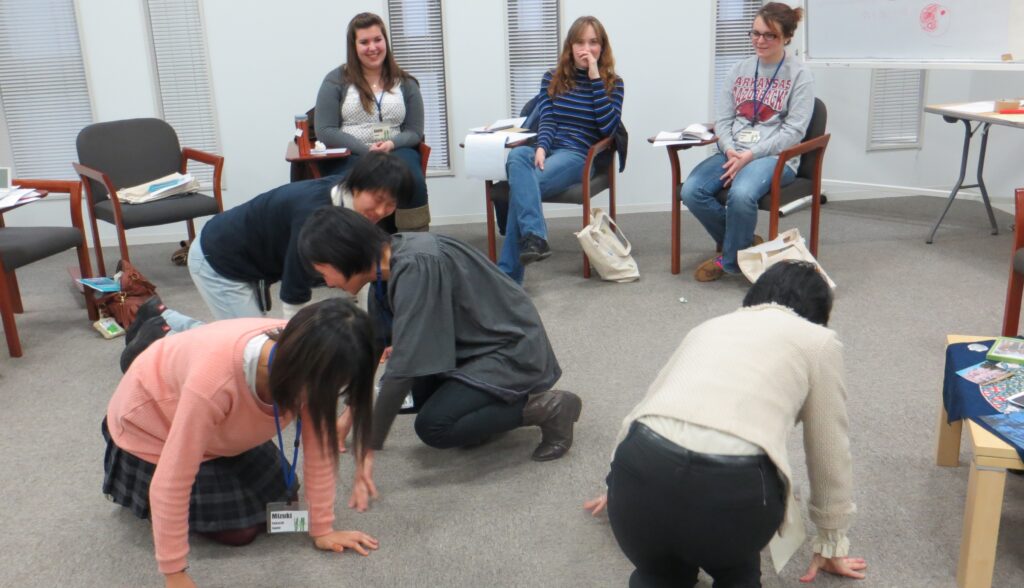
These methods convey information in a lively, often memorable, participatory way. It can help break through fears of graphs and charts (though you might use written charts to back up the illustrations). While these methods can be effective in the classroom and leadership development events, they also can be an excellent attention grabber at a protest, public gathering, etc. where you want to reach a large number of people who are not going to sit down and listen to you.
With sculptures, people position themselves in ways which express power relationships. (The facilitator provides the prompt, the particular topic for the sculpture.) The result is a generally static human sculpture which represents the group’s understanding and knowledge of a specific issue/theme/condition. This is usually done by a subset of the entire group, with facilitated processing of the depiction – generally first with the “audience” and then those in the sculpture.
Living “machines” come from Augusto Boal’s Theater of the Oppressed toolkit. They may begin with static sculptures that then move, or from the beginning, are a “machine” of moving parts which illustrate some concept or condition. Facilitator(s) can then invite either the actors or the audience to alter the “machine” to show transformation and justice relationships.
Live illustrations encompass a variety of techniques for sharing information in a lively, participatory way. It can involve using people’s bodies or objects to illustrate data/facts or relationships. Objects might be: a cake, pizza or pie (real or pictured) which would get cut up (and possibly eaten!). The illustrations can include visual enactments of a single moment in time of a certain data point, or illustrate how a particular statistic changes over time. Examples of statistics might be the distribution of wealth in the US or various countries’ greenhouse gas emissions.
►EXAMPLE: Sometimes live illustrations can be used as a combined strategy to wake up, educate folks, and introduce some policy advocacy work. For example, at a United Methodist Women convention of roughly 10,000 attendees, some directors dressed up as waitresses and had serving trays overflowing with plastic model tanks, troops, airplanes, etc. depicting the amount of the US budget devoted to military spending. In their apron pockets, they had a “bill” with the amount of money involved – compared to spending for education, housing, addressing poverty, etc. They walked around the convention hall with the tray in one hand and tapped people on the shoulder asking them “Did you order this?” They then showed them the bill…
“Naming the Moment: Political Analysis for Action” by Deborah Barndt

Naming the Moment is a method of popular education community organizing (developed in Toronto between 1986 and 1996) that uses participatory methods to research and analyze social, economic, and political issues, and develop campaigns for social change. One core method is conjunctural analysis. Popular educators who were staff of the American Friends Service Committee in Chicago created a similar process called “Coyuntura” which analyzes political-economic trends. [See a description of Coyuntura above.]
Naming the Moment also includes the use of many other techniques such as popular theater, collective art production, media analysis, zine production, and much more.
► FACILITATION TIPS:
- This process takes the equivalent of at least two to three days.
- If this is a community-wide project then it is best designed and organized as a series of workshops over several weeks.
- If it is done within one organization, then it’s best to plan for at least the equivalent of two days.
You can freely download the original manual for Naming the Moment from:
http://persuasionsanddesigns.com/index.php/resources
Popular theatre/Teatro Popular
Emerging from the work of Augusto Boal of Brazil, and other sources as well, Popular theater has many styles. The term refers to a large set of community-based and participatory theater practices that are used for community organizing and popular education. From organizing fisherwomen in Barbados around climate justice to protesting labor issues with an unscrupulous developer in Minneapolis, MN – this approach can be very effective. Popular theater has many styles. While street theater may be for “flash” public actions, other formats work well for private workshops and gatherings as a way to understand concepts, problem-solve, or work through feelings and conflicts, among other uses.
► FACILITATION TIPS:
- Various types of popular theater are very well-suited to public protest (e.g. agit prop using bankelsang or cantastoria; street theater; giant puppets)
- Some types of popular theater are excellent for workshop and classroom learning (e.g. skits, socio-dramas).
- Some types of popular theater are excellent for deep dives into the political and social-psychological dimensions of struggles for justice (e.g. Theatre of the Oppressed, Theatre for Living).
- All forms of popular theater are excellent for creating visuals that might have uses beyond the context of classroom use or single performances (e.g. getting the attention of mass media; multiplying your message through social media and other on-line means for which images play a big role in attracting readers’ attention).
A resource manual on popular theater techniques for workshop settings can be found at:
http://persuasionsanddesigns.com/wp-content/uploads/2019/10/Ready_For_Action.pdf
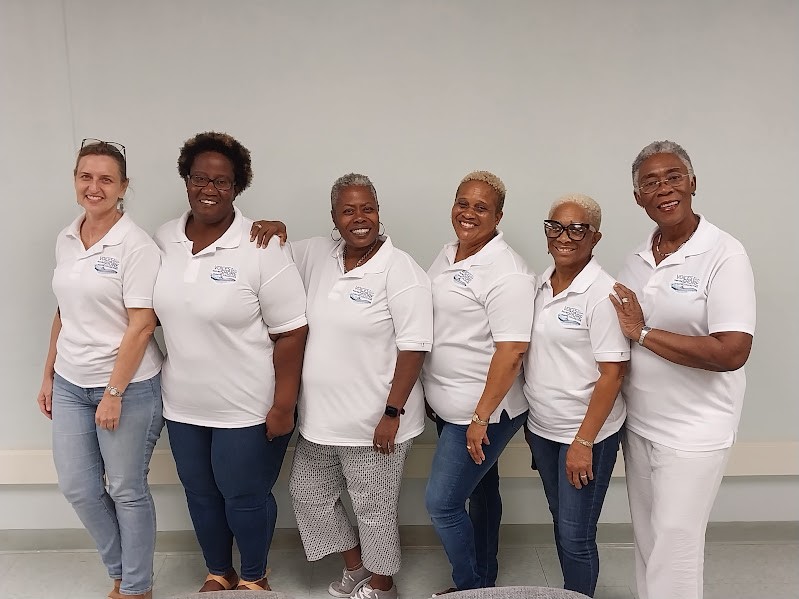
EXAMPLE: Voices from the Shore Theatre Collective
Nine women from Barbados form the current core of this collective which was the result of a popular theatre training in 2022. Voices from the Shore harnesses the power of Popular Theatre for community engagement to shed light on pressing issues affecting the fishing industry, as well as to amplify the voices of marginalized communities, particularly women whose livelihoods are intricately tied to the ocean. Through this creative process, they deconstruct the complexities of social justice, explore themes of gender equality, economic empowerment, and identify climate injustices within the Caribbean and the world. Their work is an intersectionality of the Arts and activism, using Popular Theatre techniques as a catalyst for change where their presentations are not geared merely to entertain, but more so to educate, inspire dialogue, and mobilize communities towards collective action. With every video, workshop, and community event, they strive to create a more just and sustainable world for present and future generations. Through advocating for social, economic, and climate justice, they draw from their lived experiences as women whose lives are intricately interwoven with the sea. Michelle Barrow of Barbados and some of her fisherwomen team from Voices are now traveling beyond Barbados to facilitate workshops related to “Using Popular Theater for Climate Justice”.
In addition to popular theater used by community groups for organizing, there are also standing troupes that do popular theater full time. Popular theater groups, active around the world, include:
- Bread & Puppet Theater, Glover, VT, USA
- San Francisco Mime Troupe San Francisco, CA USA
- Yuyachkani, Lima, Peru
Storytelling, Poetry, Singing & Visual Art
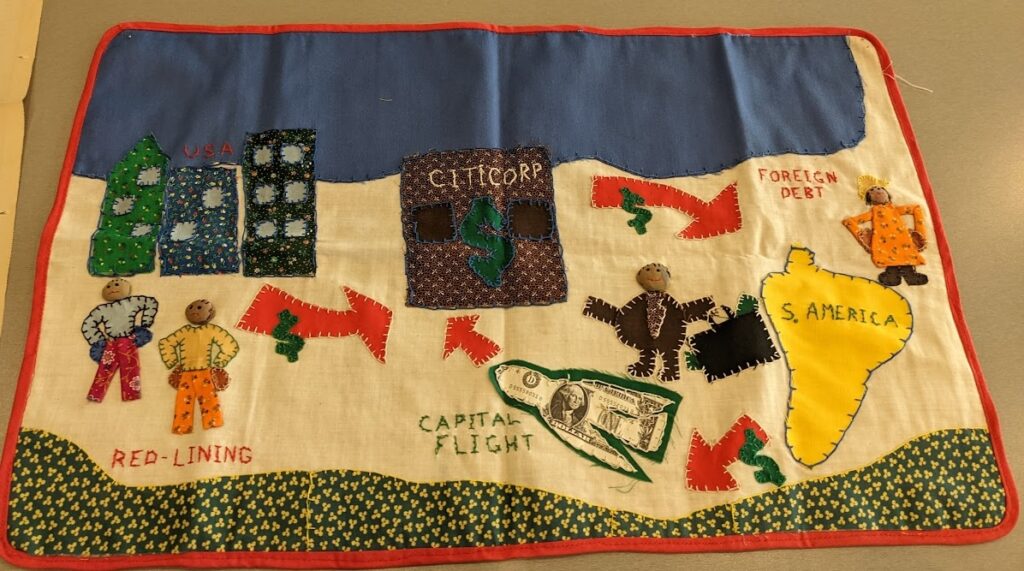
EXAMPLE: Earth to Tables. Check out the website: https://earthtotables.org an inter-cultural and inter-generational food sovereignty and food justice project begun by women. It features First Nations persons and other farmers from the Americas. The website is a gorgeous introduction to how this group utilizes storytelling and art to promote change and organizing.
Each of these art forms can take many forms and be used in a variety of ways to: build community; speak to people’s consciences and hearts; create some positive energy; invite insights to emerge individually and collectively; inform; and, move people to action.
Popular Educator Chris Cavanagh offers a very thoughtful reflection on the use of storytelling and poetry at: https://populareducation.substack.com/p/once-upon-a-time?utm_source=profile&utm_medium=reader2
A helpful resource related to using visual art is: “Starting with women’s lives: Changing Today’s Economy: A Facilitator’s Guide to a Visual Workshop Methodology” by Suzanne Doerge and Beverley Burke, Canadian Labour Congress, 2005.